

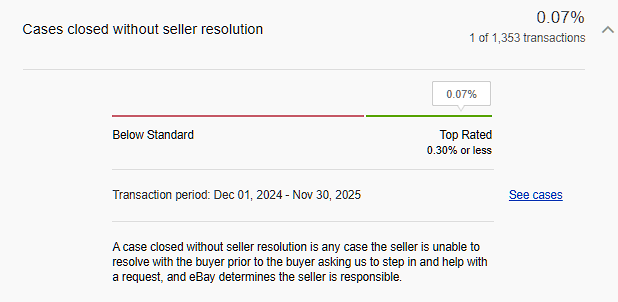
On eBay, every time a buyer has a serious problem, they can open a case through eBay’s system. Common reasons include:
- Item not received
- Item not as described
- Return or refund disputes
You’re expected to solve the issue directly with the buyer: refund, replace, resend, or work out a resolution.
A case closed without seller resolution happens when:
- The buyer asks eBay to step in, and
- eBay reviews the case and decides the seller is responsible, and
- eBay has to issue the refund or force the resolution on the seller’s behalf.
When that happens, eBay marks it as a serious defect on your account.
How this metric is measured in your seller performance
eBay uses “cases closed without seller resolution” as a core part of your seller performance standards and account health.
Within your evaluation period, you must stay under both of these limits:
- No more than 2 cases closed without seller resolution, or
- No more than 0.3% of your total transactions
Whichever is higher is used as your threshold.
These cases also flow into your transaction defect rate, which combines:
- Order cancellations by the seller (out of stock, etc.)
- Cases closed without seller resolution
If your defect rate or cases closed metric goes beyond the allowed limits, your seller level can drop to Below Standard, even if most buyers are happy.
How it impacts your seller level and account health
eBay calculates your seller level (Top Rated, Above Standard, Below Standard) every month. “Cases closed without seller resolution” directly influence that evaluation.
If you cross the allowed threshold:
- Your account can be rated Below Standard
- You may face lower search ranking in Best Match
- eBay can limit your selling, such as reducing how many items you can list
- You may be charged higher final value fees
- In more serious cases, eBay can hold funds, restrict categories, or even suspend selling privileges
So even one or two badly handled cases can do real damage, especially if you are a low-volume seller with only a few hundred transactions per year. A few unresolved cases on a small account can make your percentage spike.
Common ways sellers end up with cases closed without resolution
Most defects in this area come from a few repeat mistakes:
- Ignoring buyer messages or cases
You think the buyer is being unreasonable, so you stop replying. The buyer escalates, eBay steps in, and rules against you. - No valid tracking or proof of delivery
For “item not received” cases, if you do not upload valid tracking showing delivery, eBay almost always sides with the buyer. - Refusing a return that is covered under policy
You decline a return request even though your listing or eBay policy allows it. When the buyer asks eBay to review the case, you lose. - Shipping to the wrong address or with big delays
If the item arrives very late or is misdelivered and you cannot prove otherwise, that case can close against you. - Trying to solve it off-platform
Asking buyers to cancel cases in exchange for something, instead of resolving properly through eBay, often backfires when they escalate.
Why this metric hits harder than regular negative feedback
Negative feedback hurts, but cases closed without seller resolution hurt more because:
- They are directly counted in your core performance metrics
- They can tip your account into Below Standard, even if your feedback % looks good
- They send a strong signal to eBay that you do not handle problems when things go wrong
You could have 99% positive feedback and still be at risk if your defect metrics are high.
How to avoid cases closing against you
Think of every open case as a ticking clock. Your only goal: resolve it before eBay has to step in.
Here are practical steps:
1. Respond fast and stay polite
Reply to cases within 24 hours (sooner if possible). Clear, calm communication often prevents escalation.
2. Always use tracked, reliable shipping
Upload tracking on time and use carriers that provide dependable scans. Tracking is your best defense in “item not received” disputes.
3. Know when it’s cheaper to refund
Sometimes the smartest move is:
- Quick refund
- Or a free replacement
Yes, you lose some money on that transaction, but you protect your seller level, which is worth much more in the long run.
4. Stick to eBay’s return and refund rules
If a case clearly falls under eBay Money Back Guarantee or your own return policy, follow it. Trying to fight a losing battle usually ends in a defect.
5. Fix listing issues that cause disputes
If you keep getting “not as described” complaints on a certain item:
- Update photos
- Clarify sizing, condition, or compatibility
- Mention defects clearly
Honest, detailed listings dramatically reduce cases.
What to do if you already have several cases closed without seller resolution
If your metrics are already red or close to the limit, you need a damage-control plan:
- Check your Seller Dashboard
Review how many cases you have, what percentage they represent, and which buyers/transactions caused them. - Stop the bleeding
For any new dispute, resolve it aggressively before escalation. Offer partial refunds, full refunds, or replacements if needed. - Improve handling and shipping immediately
Ship on time, upload tracking, and avoid overselling. Fewer issues mean fewer chances for new cases. - Plan to dilute the percentage with clean sales
The more problem-free transactions you complete, the lower your overall defect percentage becomes over time. - Appeal only when you clearly meet protection rules
If a case was opened due to something outside your control (for example, the buyer misused the system or tracking proves they were wrong), you can contact support and request a review. Use this only when you have strong evidence.
Final takeaway: protect the metric that protects your account
“eBay cases closed without seller resolution” might sound like a technical phrase, but in reality it means:
You didn’t fix the buyer’s problem, so eBay had to step in and do it for you.
When that happens too often, eBay starts treating your account as risky. The result can be:
- A lower seller level
- Reduced visibility and sales
- Extra fees, limits, and restrictions
If you treat every case as urgent and resolve issues before eBay gets involved, you safeguard your account health, maintain a strong seller level, and keep your eBay business growing instead of fighting for survival.
Source note (not part of the blog):
This explanation is based on eBay’s official seller standards and seller performance policy, including their thresholds for cases closed without seller resolution (no more than 2 cases or 0.3% of transactions, whichever is higher) and how these affect seller levels and potential Below Standard consequences.
Leave a Reply