
If you’re trying to get approved to sell Human Ingestible products on Amazon—things people eat, drink, or swallow like supplements, powders, gummies, etc.—you’re playing in a heavily regulated playground.
Amazon doesn’t just want to know what you’re selling. They want proof that:
- You are a legitimate business.
- Your products are coming from proper manufacturers or distributors.
- You can handle real inventory (not just dropshipping random stuff).
And the number one document that decides your fate?
Your invoice.
In this blog, we’ll break down Amazon’s own requirements and turn them into a simple, clear, step-by-step system so your application doesn’t get rejected over something silly like a wrong address or a 100-unit invoice.
What Is the “Human Ingestible” Subcategory?
“Human Ingestible” is Amazon’s internal way of grouping products that are consumed by humans, such as:
- Dietary supplements
- Vitamins & minerals
- Herbal products
- Protein powders & nutrition drinks
- Gummies, capsules, tablets intended for ingestion
Because these products directly affect health, Amazon is extra strict. That’s why they require specific documentation when you request approval to sell in this subcategory.
Amazon’s Invoice Requirements – Explained in Plain English
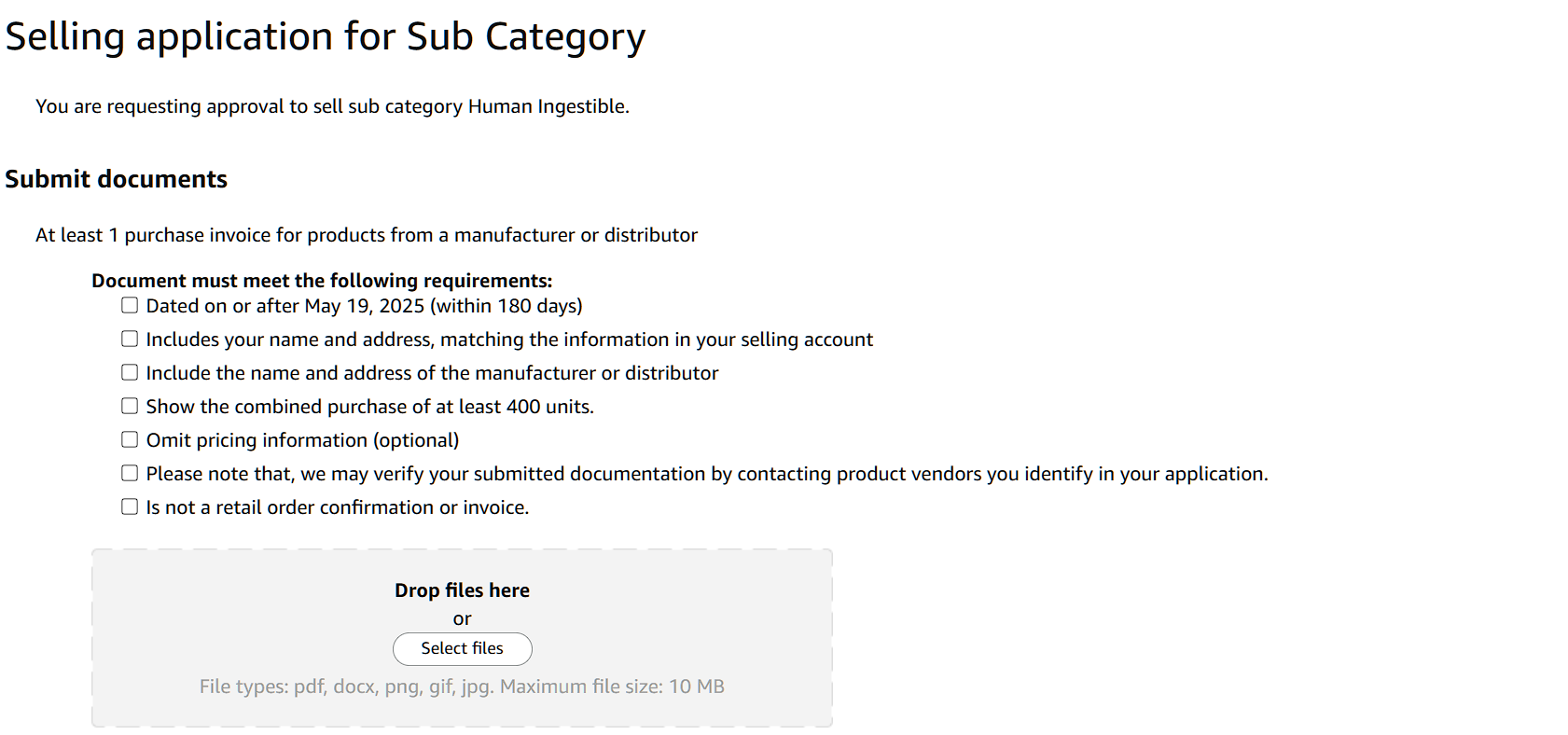
Here are the key requirements Amazon mentions (simplified):
- Invoice must be recent (within 180 days)
Your document must be dated within the last 180 days from the time of application.- Old invoices = red flag.
- Aim for something from the last 1–2 months if possible.
- Your name and address must match your Amazon seller account
The invoice must show:- Your business name (or legal name if you’re an individual seller)
- Your address
And these must match exactly with what’s on your Amazon Seller Central account.
Tiny mismatches like: - “Street” vs “St.”
- Old address vs new address
- Different company spelling
can cause unnecessary rejections.
- Invoice must show manufacturer or distributor name and address
The invoice cannot be from a random retail store. It should clearly show:- Manufacturer or authorized distributor
- Their full name and address
This proves to Amazon that you’re sourcing from a legitimate upstream supplier, not from retail shelves.
- Invoice must show combined purchase of at least 400 units
Across your invoice(s), you must have a minimum of 400 units purchased.
That could be:- 400 units of 1 product, or
- A mix of SKUs adding up to 400 units total
- You may omit pricing (optional)
You can:- Ask your supplier to omit pricing, or
- Black out the pricing manually (digitally or with a marker),
as long as all other details remain visible and readable.
- Invoice must not be a retail order confirmation
These are not acceptable:- Amazon purchase receipts
- eBay purchase screenshots
- Walmart, Costco, Target receipts
- Order confirmations from retail websites
- Amazon may contact your supplier to verify
They might email or call the manufacturer or distributor to confirm:- That the invoice is real
- That you really purchased those items
How to Prepare a Perfect Invoice for Human Ingestible Approval
Here’s a practical step-by-step path to build a clean, Amazon-ready invoice.
1. Choose the right supplier
Pick a wholesale supplier, brand owner, or authorized distributor, not a retail store.
Before ordering, confirm that the invoice will include:
- Your legal/business name & address
- Supplier’s name & address
- Product details (names, quantities, SKUs)
If your supplier doesn’t normally add full address info, ask them to.
2. Order at least 400 units
Plan an order that meets Amazon’s minimum:
- Example:
- 4 SKUs × 100 units each = 400 units
- 2 SKUs × 200 units each = 400 units
You don’t need one single product with 400 units. It’s the combined total on the invoice that matters.
3. Make sure your seller account info is updated before ordering
Go to your Amazon Seller Central:
- Check your Business Name
- Check your Business Address
Match those exactly on your invoice. If your seller account has “Suite 12-B”, get that same format on the invoice.
If you recently changed address, update Amazon and inform your supplier before issuing the invoice.
4. Request a clean, professional invoice from your supplier
Ask your supplier to issue an invoice that includes:
- Invoice date (recent, within 180 days)
- Your correct name & address
- Their correct name & address
- Product names & quantities
- Total quantity clearly visible (so Amazon can see 400+ units)
If you want pricing hidden, either:
- Ask the supplier to remove pricing, or
- Manually black it out later (but don’t touch other parts).
5. Double-check readability
Amazon reviewers are human. If your document is:
- Blurry
- Cropped
- Too small
- Low resolution
…there’s a chance they’ll reject it simply because they can’t read it properly.
Export or scan your invoice in PDF or high-quality image format that’s crystal clear.
Common Mistakes That Get Applications Rejected
Here are some real-world errors that cause approvals to fail:
- Retail receipts instead of invoices
- Buying from Amazon, Walmart, or local stores and submitting those receipts = ❌
- Invoice older than 180 days
- “But I bought stock last year” won’t matter. Old invoices are often auto-rejected.
- Name mismatch
- Seller account shows “ABC Trading LLC”
- Invoice shows “ABC Traders”
Even small differences can create doubt.
- Personal name on invoice, company name on Amazon (or vice versa)
- If you’re using a company account, keep everything uniform.
- If you’re a sole proprietor, try to keep one consistent identity.
- No supplier address
- Invoices with only the supplier’s name and email or phone, but no proper address, can be rejected.
- Less than 400 units
- 200 or 300 units may not cut it. Don’t “test” the system—just meet the requirement.
- Heavily edited or suspicious invoices
- Over-editing, weird fonts, or obvious copy-paste makes Amazon suspicious.
- If they call the supplier and the supplier denies the invoice, you’re in trouble.
Final Pre-Submission Checklist
Before you hit “Submit” on your Human Ingestible selling application, go through this quick checklist:
- ✅ Invoice date is within the last 180 days
- ✅ Your seller account name matches the buyer name on the invoice
- ✅ Your address matches exactly
- ✅ Manufacturer or distributor name and full address is visible
- ✅ Combined quantity of all SKUs is 400 units or more
- ✅ No pricing visible (if you chose to remove it), but product and quantity details are intact
- ✅ Document is clear, sharp, and readable
- ✅ Invoice is not from a retail store or marketplace
- ✅ You’re confident your supplier will confirm the purchase if Amazon contacts them
If you can check all those boxes, your chances of approval jump significantly.
Conclusion: Treat Your Invoice Like Your Golden Ticket
When it comes to selling in Amazon’s Human Ingestible subcategory, your invoice isn’t “just paperwork.” It’s your golden ticket.
- It proves you’re a real seller.
- It proves your products come from proper sources.
- It tells Amazon you’re ready to operate at a serious, compliant level.
Get your supplier, your details, and your quantities right the first time, and you’ll save yourself weeks of back-and-forth frustration and rejections.
Leave a Reply